

Reworlding
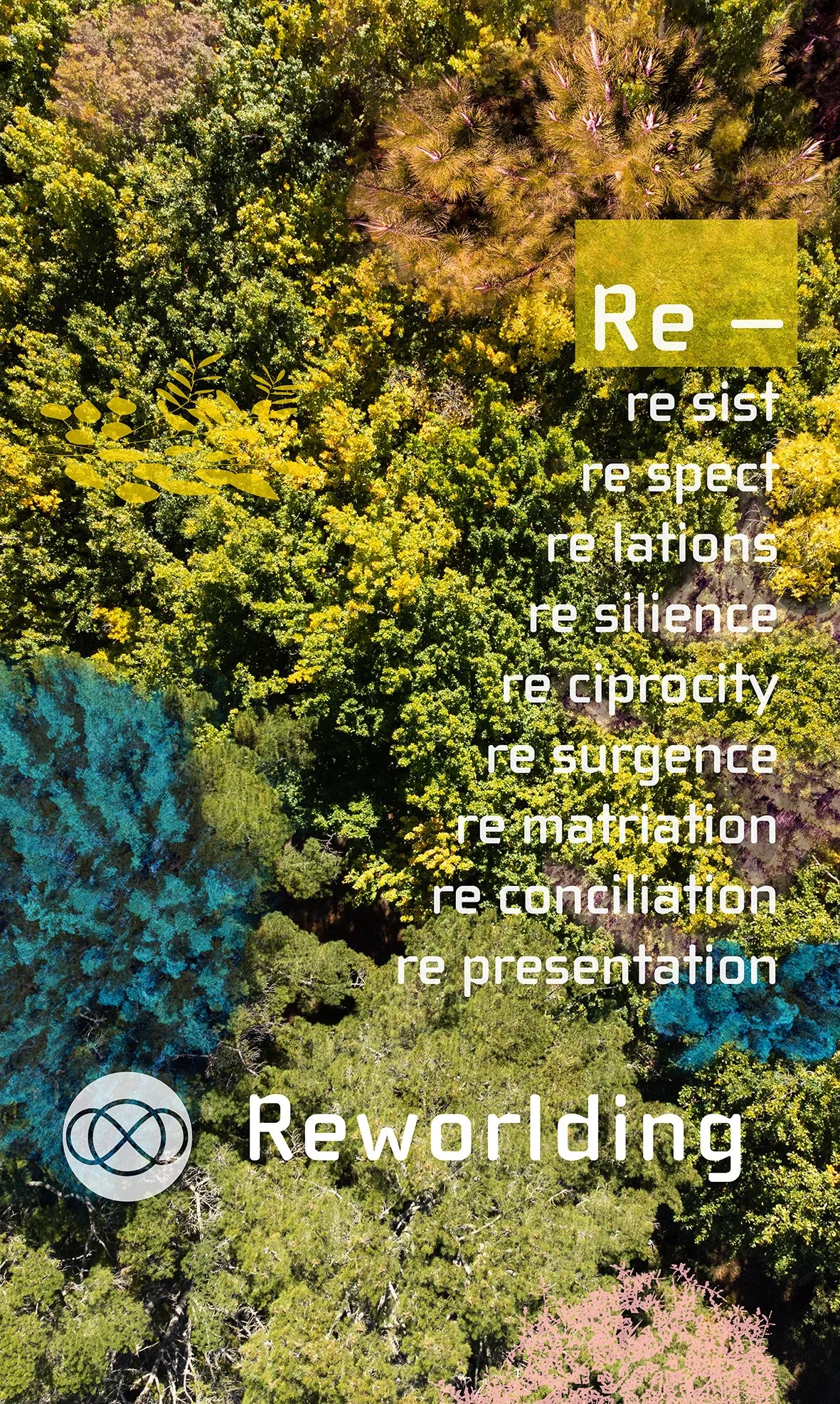
CLIMATE CHANGE is a COLONIAL CRISIS
It is the end of the world as we know it. Every beginning is an ending with a backstory, a right now, the unimaginable, the inevitable and the beyond of what might be possible. The ending teaches us where to start. Reworlding imagines a world that could have been – before colonial disruption – as our beginning – to decouple from maladaptive ways of engaging/disengaging with the climate emergency context.
At the core, colonialism is about severing and erasing relationships to land, language, culture, kin and one another.
The challenges of climate change are far more severe and complex than anticipated, with existing systems and ways of thinking poorly equipped to manage. Without the luxury of time, there is an urgency in finding ways to collaborate, experiment, plan and shift the paradigm of climate action and disaster risk reduction & resilience.
There’s no time to re-invent the wheel or duplicate efforts. It’s a time to deeply connect and collaborate in ways that we might not experience the rewards.
When we engage in deep, long relational practice, we are reworlding - connecting with all our relations. The knowledge, skills and stories are in the people.
To Reworld is to decolonise, Indigenise and collectively imagine into action a “world worthy of its children”[i] for the sake of all our future ancestors.
[i] Albert E. Kahn and Pablo Casals, Joys and Sorrows: Reflections by Pablo Casals as Told to Albert E. Kahn., ed. Albert E. Kahn (United Kingdom: Macdonald and Co. Ltd., 1970), 183.

Reworlding backstory
‘Reworlding’ was coined and first articulated in Dr Jen Rae’s speculative fiction story Centre for Reworlding: Umbilica Homepage as it relates to three Indigenous futuring and survivance relationships — rematriation, reconciliation and resurgence — acknowledging some of the tensions and contractions these concepts have in Indigenous and non-Indigenous usage.
Jen refers to Métis Elder Maria Campbell’s oration on the role of artists in reconciliation as described by Métis author Erica Violet Lee in her essay discussing Indigenous Futures. Campbell says that artists and writers are mirrors to people showing them “we build what could have been or should have been” prior to colonial disruption, which Lee writes that “by cultivating an understanding our relationships to histories, kin and land, we can begin to build new worlds[i]drawing from our complex cosmologies and reconnecting storylines”.
In their trans-temporal speculative fiction film REFUGIUM (2021), Rae & Coleman, return to the Centre for Reworlding expanding on the ideas, protocols and narrative. BILYA is also conceptualised in the film. Prompted by a question at the premier of the film in 2021 at Arts House, Rae & Coleman invited a group of colleagues and friends (many named in the film) to collectively imagine how a speculative 100-year thought exercise could become a reality and here we are.
-
While ‘worlding’ has been explored by scholars such as Haraway[ii]and Spivak[iii], Jen Rae and Claire G. Coleman are Indigenous and write from this perspective in Centre for Reworlding through praxis and art as “this decolonization/Indigenization is necessary in order to bring Indigenous epistemologies, ontologies, and practices to the fore in a meaningful and ethical way”[iv]. Reworlding also considers the ‘everywhen’ — a time that is outside of time where everything can be seen at once and where nothing new can be created, only discovered — a term originally coined by anthropologist W.E.H. Stanner in his 1956 essay The Dreaming[v], a highly regarded piece of writing on race relations and Australian Aboriginal culture. The everywhen acknowledges that time is non-linear encompassing past, present and future simultaneously and is integrated as a way of life for many First Peoples. Reworlding is an active presence of looking back to look forward, always acknowledging the eternal now. This time we live in, the Anthropocene, is therefore also part of the everywhen. The questions explored in our film REFUGIUM is the unearthing and what we attempt to do together through the Centre for Reworlding is the reorganising — refugia.
Speculative practices can provide the ability to see and shape the world in a different way – to divide our reality from our imaginings, and to decouple our history and future from time in the everywhen. The long imaginary helps us prepare, prioritise and know what’s worth fighting for when hope becomes fleeting.
Social change has always been a topic for speculative fiction — to transcend realities and corporealities. In the climate emergency context, as global temperatures rise at accelerating rates, timescales and impacts expand and detract, and we become numb to lives lost daily from disease and disaster — now more than ever, there is a role for arts and culture to lean into the tensions, to tell the unpalpable stories along with the rousing, and to ensure we have skin in the long game.
Exploring risk through experimental speculative practice invites failure as fodder for learning together with audience, communities and participants. It is part of the reorganising of thinking and relations. One of the limitations and challenges of climate emergency communication is its “failure to activate the public imagination to the potential risks and consequences of disaster especially in an urban context”.[vi] . Whereas artists are deeply embedded in the discipline of the imagination allowing us to see with collaborators and audiences alternate futures, to delve into scenario mapping and to practice hypotheticals where the stakes are lower, risks can be explored and failures allow for course correction/re-direction.
-
Excerpt from the publication
RAE, J. & COLEMAN, C., G. 2022. Reworlding: Speculative futuring in the endtimes, in the everywhen. In: HJORTH, L., JUNGNICKEL, K., LAMMES, S. & RAE, J. (eds.) #Failurists: Reflections on and critical interventions in the field. Amsterdam: Institute of Network Cultures. E-book available for free.
References
[i] Erica Violet Lee, "Reconciling in the Apocalypse," The Monitor (2016), https://policyalternatives.ca/publications/monitor/reconciling-apocalypse.
[ii] Donna Haraway, Staying with the Trouble (Durham, N.C.: Duke University Press, 2016).
[iii] Gayatri Chakravorty Spivak, "The Rani of Sirmur: An Essay in Reading the Archives," History and Theory 24, no. 3 (1985).
[iv] Zoe Todd, "Indigenizing the Anthropocene," in Art in the Anthropocene: Encounters a Mong Aesthetics, Politics, Environments and Epistemologies, ed. Heather Davis and Etienne Turpin (London: Open Humanities Press, 2015).
[v] William Edward Hanley Stanner, ed. The Dreaming, Reader in Comparative Religion: An Anthropological Approach (New York: Harper and Row, 1972).
[vi] Alison McMillan, Alan March, and Jen Rae, Arts House Listening Program, podcast audio, REFUGE: Adaptation 2017, https://bit.ly/3S3lEBV.